
When a creator leaves an agency, the exit itself is usually the easy part. The hard part is the money already in motion: sales made before her last day that haven't paid out yet, a split that hasn't settled, and chargebacks that can arrive after she's gone. The way to handle it is to decide in advance which earnings the agency's split applies to, and to close out the payouts with a final statement both sides can check.
1. Money in motion on the last day
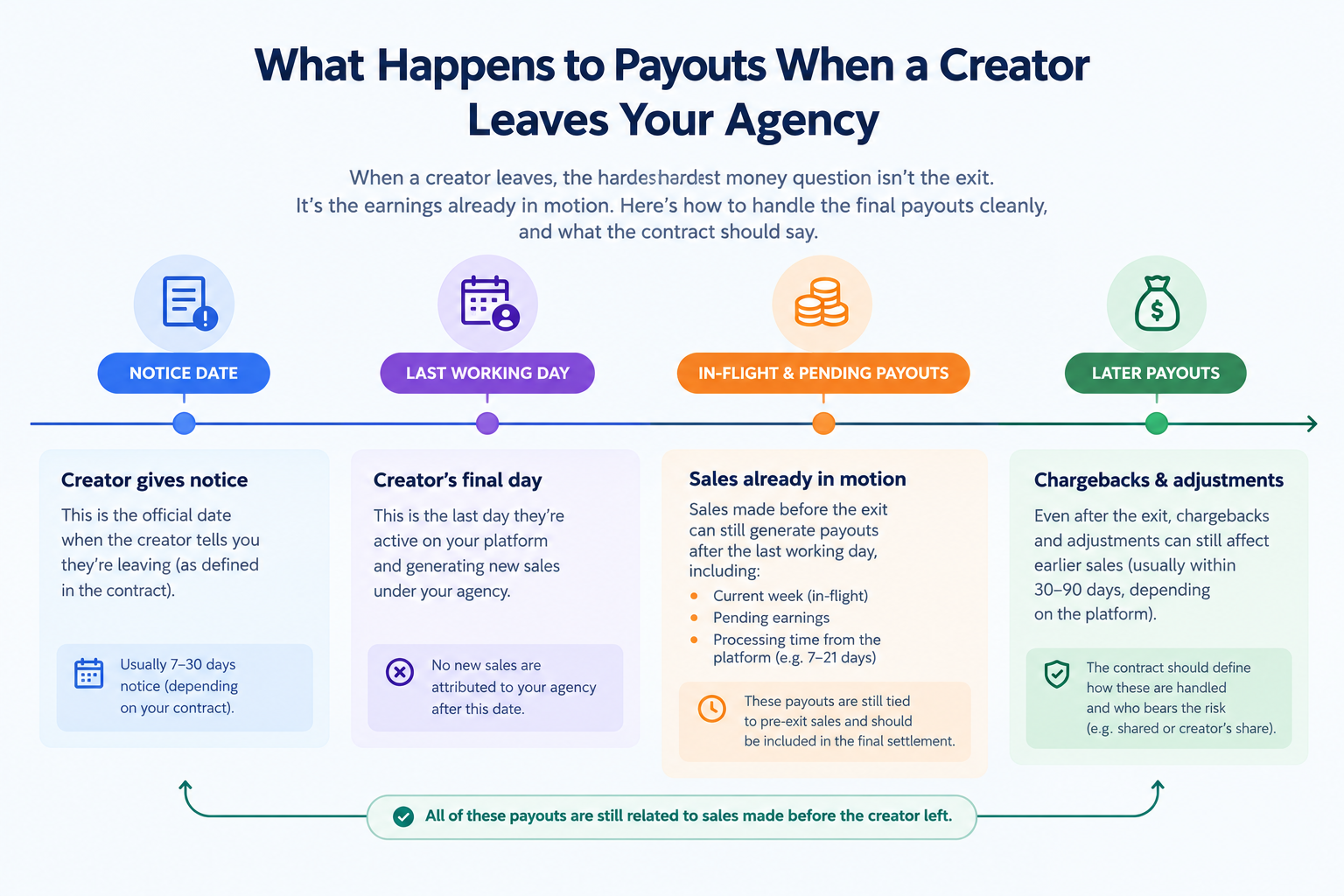
On any given day, a creator's earnings are at different stages. Some have already paid out and been split. Some are in OnlyFans' pending period and haven't been released yet. Some are sales that haven't had a chargeback window run out.
So "the last day" doesn't mean "no more money." The key question is which of those amounts the agency's split applies to. The contract should say, and the simplest, clearest answer is to tie it to the date of the sale or the date of the payout, and to say which.
2. Decide the cutoff basis
There are two common ways to draw the line:
- By sale date. The agency's split applies to everything earned through the last day, even if it pays out after she leaves. This is usually the cleaner approach, because the agency did the work that produced those earnings.
- By payout date. The split applies only to payouts released before a set date, so later releases belong entirely to the creator.
Neither is automatically right. The first protects the agency's work in the final weeks. The second is simpler to administer. What causes disputes is leaving it unstated, so each side assumes the other's version.
3. What continues during the notice period
Most agreements give a notice period before the end date. Published guides cite anything from 14 to 90 days, with 30 to 60 most often recommended by creator-side sources, so there's no single norm.
During that period, three things should continue as normal:
- The split. The agreed percentage applies to earnings as before.
- The service. The agency keeps doing the work it's being paid for. Reducing service during notice is a common source of ill feeling.
- The reporting. Both sides keep seeing the same reconciled numbers.
4. Chargebacks and adjustments after she's gone
A chargeback can arrive weeks after the sale, sometimes after the creator has left. If the contract only covers the active relationship, nobody has agreed who bears it. We cover the mechanics in how chargebacks affect an agency split, and the exit agreement should state how reversals are handled for a set period after the end date, for example by netting them against the final payout.
The same goes for chatter commission on sales made before she left. See chatter commission structure.
5. Post-termination commission
Some agreements claim a percentage of earnings for a period after the creator leaves, often called a tail. Creator-side guides describe long tails as a red flag, and some jurisdictions may restrict or refuse to enforce them.
This is a clause to treat carefully. If an agency includes one, it should be clear, limited in time, proportionate to the work the agency actually did, and reviewed by a lawyer in the relevant jurisdiction. An aggressive tail tends to turn a clean exit into a dispute, which is rarely worth the money it recovers.
6. Close out the money cleanly
When the end date arrives, the goal is a clean financial finish:
1. Process the final payouts. Apply the agreed split to everything the contract says it applies to, including pending earnings that release after the end date. 2. Issue a final statement. One reconciled statement showing earnings, fees, adjustments and each party's share, sent to both sides. 3. Set an objection window. A defined period after the statement during which either side can raise a discrepancy. We cover this in payment terms every agreement should include. 4. Stop the split rule and close access. Once the last amounts have settled, the agency's reporting access ends and the split stops.
If a disagreement does come up, resolve it through the process in the contract. Don't hold back money she's already earned, because that creates its own legal exposure. See can an agency freeze a payout over a breach.
7. Why the account setup matters at exit
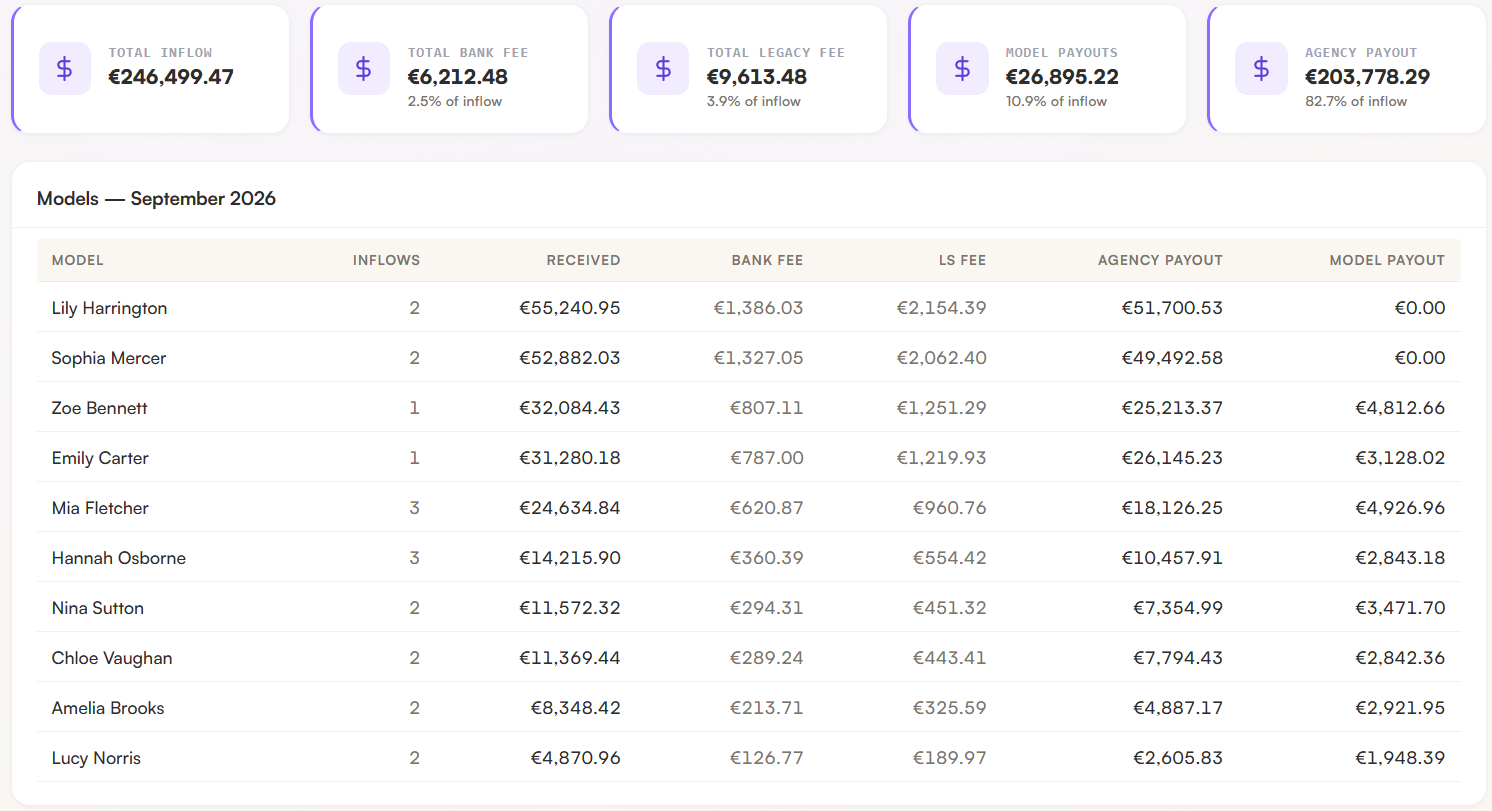
Exits are much messier when the agency has been operating accounts in the creator's name. Then there are logins to hand back, balances to untangle and no clear record of who owned what. That's one of the reasons we recommend keeping account management and bank ownership separate.
When each party holds her own account and the agency never had her credentials, there's nothing to untangle: her account stays hers, the agency's share has already been settled, and the final statement shows the rest.
What to put in the contract
- Notice length and the form it must take (written, to whom).
- Whether the split and service continue during notice.
- The cutoff basis, sale date or payout date.
- How earnings still in the pending period are handled.
- How chargebacks and adjustments are handled for a period after exit.
- Chatter commission on in-flight sales.
- Whether any post-termination commission applies, and if so, for how long and on what.
- A final statement and an objection window.
- What happens to access and tools on the end date.
Frequently asked questions
Does the agency still get its share after a creator leaves?
For earnings covered by the contract, yes. Whether that includes sales made before her last day that pay out afterward depends on the cutoff basis the contract uses, which is why it should be written down.
How much notice should a contract require?
Published guides vary, from 14 days to 90 days, and creator-side sources often recommend 30 to 60. The right length depends on the services involved and the jurisdiction, so there's no single answer.
Can an agency charge a fee for leaving early?
Some agreements include one, but creator advocates often criticize them, and they may be limited or unenforceable in some places. Get legal advice before including one or relying on one.
What happens to chargebacks that arrive after the creator leaves?
That should be in the agreement. A common approach is to set a period after the end date and net any reversals against the final payout, but the allocation is a decision for the two parties.
Does leaving mean the creator loses her OnlyFans account or earnings?
No. The account and the earnings are hers. What the agency has is a contractual right to its agreed share of earnings covered by the agreement, and nothing more.