
Reconciling payouts means checking, every week, that the amount a platform says it paid matches what actually arrived, and that the agreed split was applied correctly to each model. Done on a fixed day with the same seven steps, it turns payout mistakes into a five-minute fix instead of a three-week argument.
Most disputes between agencies and models aren't about bad faith. They happen because two people hold two slightly different sets of numbers, and nobody ever compared them. This checklist is built to make sure there's only one set. It works with a spreadsheet, and it works with software.
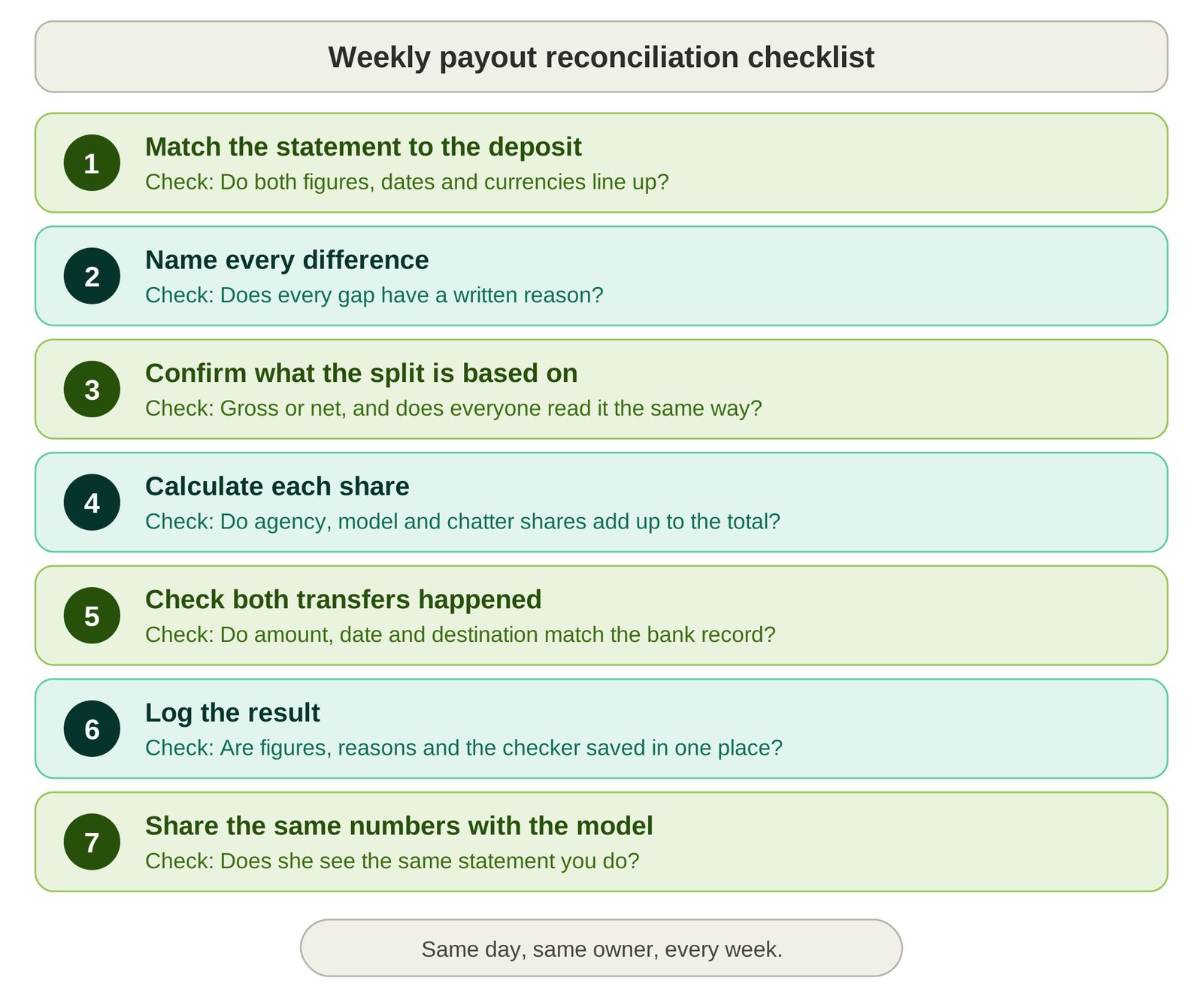
Before you start
Pick a fixed day and a fixed owner. A reconciliation that happens "when someone has time" is the one that gets skipped in a busy week.
Then gather three things for each model:
- The platform statement for the period.
- The bank record showing what actually arrived.
- The contract terms for the split, including what the percentage is calculated on.
1. Match the statement to the deposit
Put the platform's figure for the period next to the amount that landed in the bank. They will often differ a little. That's normal, as long as you can explain the gap.
- What to check: the two figures, the dates, and the currency of each.
- A warning sign: a gap nobody can explain, or a deposit that arrives with no matching statement.
2. Name every difference
A gap with a reason is a note. A gap without one is a problem waiting to grow. Write the cause next to every difference, every week.
- Common causes: platform fees or holds, refunds or disputes that were deducted, currency conversion, bank or transfer fees, and timing, where a payment lands in the next period.
- A warning sign: "unknown" showing up for the same model two weeks in a row.
3. Confirm what the split is calculated on
Gross, net of platform fees, or something else. The same "50% split" can produce very different numbers depending on that one word. We break down how much in [gross vs. net contract math](/blog/gross-vs-net-onlyfans-contract-math).
- What to check: the contract wording, and that your team and the model read it the same way.
- A warning sign: a contract that just says "50%" with no base, or a base that has changed in practice without anyone updating the document.
4. Calculate each share
Work out the agency share and the model share from the confirmed base. If chatters earn a commission, calculate it separately against the same base so the figures stay in line.
- What to check: that the agency share, the model share and any chatter commission add up to the amount you started from.
- A warning sign: shares that don't add up to the total, even by a small amount.
5. Check that both transfers actually happened
A split that was calculated but never sent is the most common hidden error. The numbers on the sheet look right, and the money is still sitting in the wrong place.
- What to check: the amount, the date and the destination of each transfer, against the bank record.
- A warning sign: a transfer marked "done" with no bank record behind it.
6. Log the result
One line per model per period: the figures, any differences with their reasons, and who checked them. The log is what lets you answer a question months later without rebuilding the week from scratch.
- What to keep: the platform statement, the bank record, the calculation, the difference notes and the statement you shared with the model.
- A warning sign: records spread across chats, screenshots and inboxes.
This is general guidance, not tax or legal advice. Ask a qualified accountant how long to keep records in your country.
7. Share the same numbers with the model
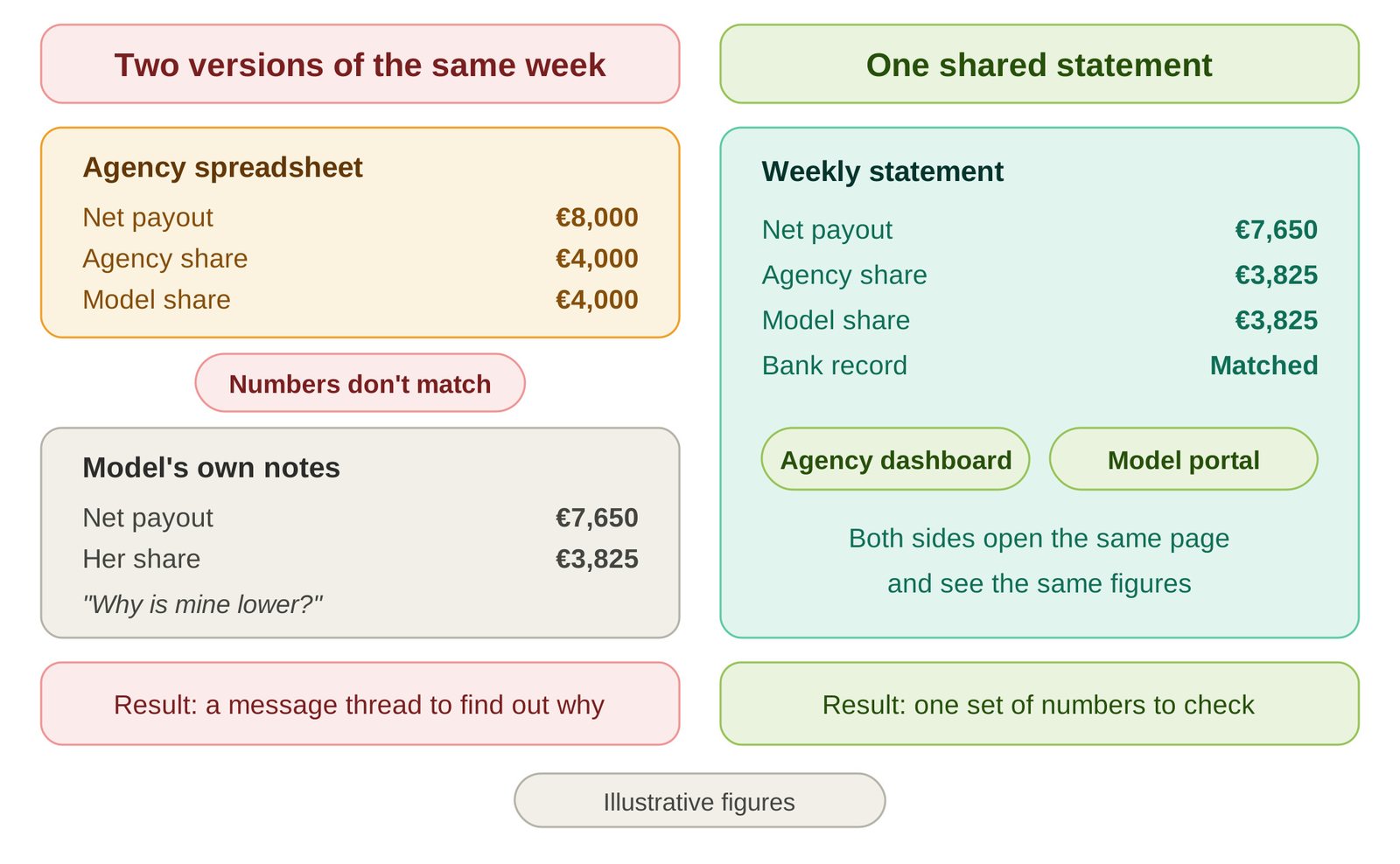
If she sees a different set of figures from yours, you're back to two versions of the truth. The simplest fix is the same statement for both sides.
- What to check: that the model receives the same figures you reconciled, not a summary written separately.
- A warning sign: questions like "why is mine lower than the dashboard said?" coming in every week. That's a sign the numbers aren't shared. See how a shared ledger removes the "what did I earn" texts.
Once a month
Add up the weekly logs and check they match the monthly totals. Look for the same difference appearing every week, because that usually points to a process problem, not a one-off. Anything unexplained for more than one cycle should go to a named person with a date.
Why the manual version gets heavy as you grow
At three models, this is a short session. At twenty, it becomes a regular part of someone's week. Each new model adds another statement, another deposit and another set of differences to explain. The checklist stays the same, but the time it takes doesn't. We compare the two approaches in automated splitting vs. manual tracking.
Where Legacy Solutions fits
Software can't decide what your contract means, and it shouldn't replace a person looking at unusual cases. It can take over the repetitive steps of this checklist.
Legacy Solutions is software that sits on top of licensed banking partners. Each model has her own dedicated account, in her own name, and the agreed split runs automatically when the payout lands. In practice that covers a lot of the list above:
- Step 3 and 4: the agreed percentage is set up once and applied the same way every time.
- Step 5: the split executes at the banking level, so there's no separate transfer for someone to forget.
- Step 6: every period leaves a record, with statements downloadable as PDF or CSV.
- Step 7: the agency and each model log into their own dashboards and see the same figures.
Legacy is software only. It never holds, receives or transfers funds. The accounts and transfers sit with the licensed banking partner. You still check the exceptions, which is the part of reconciliation that needs a person.
[Image: Legacy Solutions dashboard showing one model's weekly statement with inflow, fees, agency share and model share on a single view.]
If you'd like to see how it would look on your own numbers, you can apply at legacysolutions.vip.
Frequently asked questions
How often should an agency reconcile payouts?
Weekly is a sensible default for agencies that pay out weekly, because errors are easier to trace when they're recent. Add a short monthly check on top.
What's the most common cause of a payout mismatch?
Usually a mix of platform deductions, timing, currency conversion and fees. The fix is to record the reason for every gap each week, not just the total.
Should the model see the reconciliation?
Yes, ideally the same statement the agency uses. Shared figures cut down questions and suspicion on both sides.
Do I still need a contract if I use software?
Yes. Software applies the terms, but the contract defines them, including what the split is calculated on and what happens at termination.
How long should I keep payout records?
It depends on your country and business structure. Ask a qualified accountant, and keep the records somewhere you can retrieve quickly.