
A chargeback is a bank-initiated reversal of a fan's payment. According to OnlyFans' terms, it may deduct the creator-earnings portion of that payment from the creator's balance. For an agency split, the question isn't whether chargebacks happen. It's who bears them, and what happens when one lands after the split has already settled.
1. How a chargeback reaches a payout
A chargeback starts with a fan disputing a charge with their own bank. The bank reverses the payment, OnlyFans is notified, and the amount comes out of the creator's balance. The creator has very little say in the outcome. OnlyFans may submit evidence on her behalf, but there's no guarantee it wins, and a lost dispute isn't reimbursed.
Two points matter for agencies:
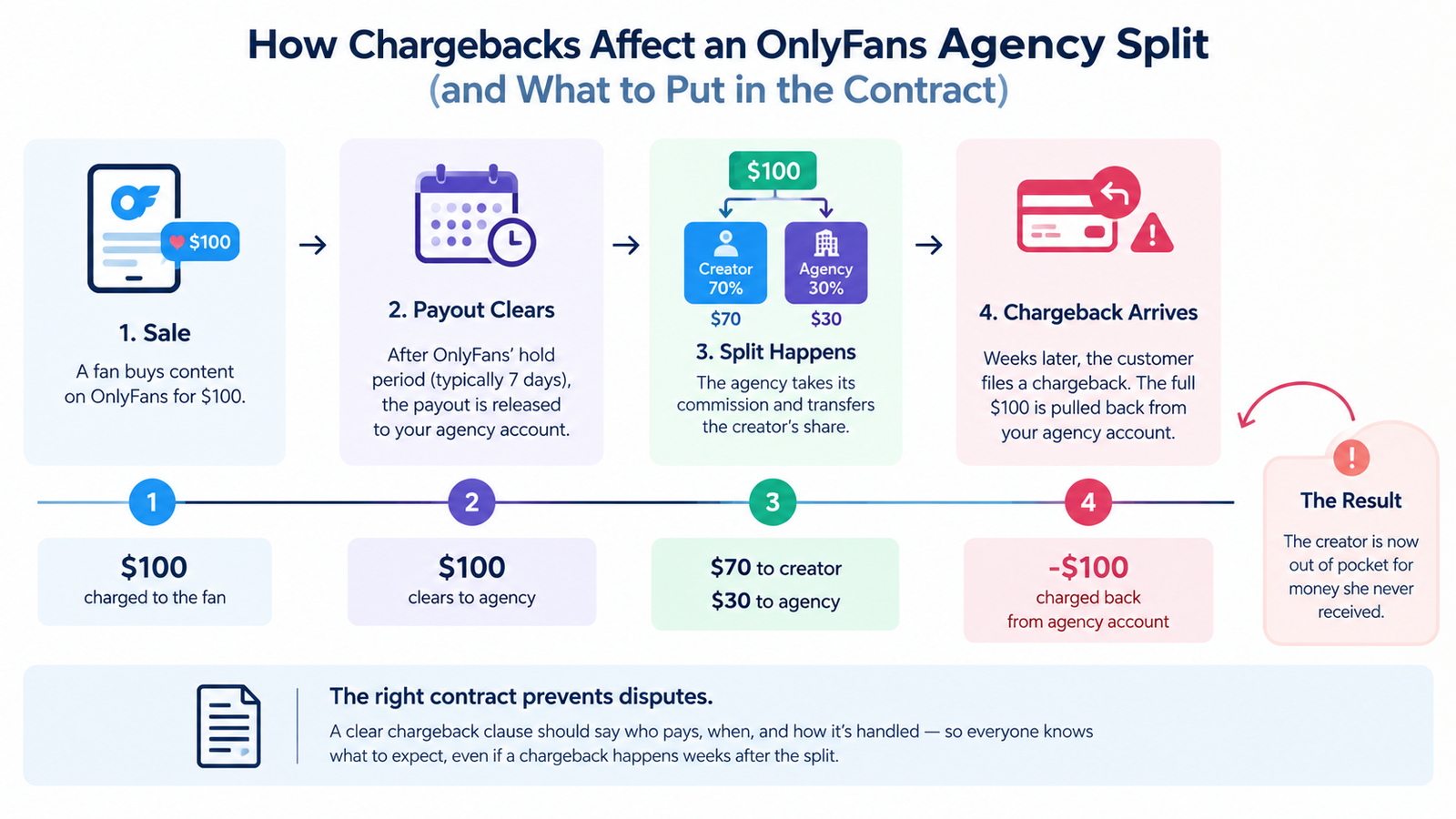
- It can arrive late. A chargeback can come well after the original sale, sometimes weeks later. By then the payout it relates to may already have cleared and been split.
- It's different from a refund. A refund is a decision OnlyFans makes. A chargeback is a decision the fan's bank makes.
Repeated chargebacks can also put an account at risk of payout holds or restrictions, according to several creator guides, which makes them a risk for the agency as well as the creator.
2. Why chargebacks complicate an agency split
If a chargeback lands while earnings are still pending, it's simple: OnlyFans removes the amount before the payout is released, and the split applies to the smaller number.
The problem is the other case: the payout has cleared, the split has settled, and a chargeback is then deducted from a later payout. Three questions follow:
- Which amount? The fan's full payment, or the creator-earnings portion after the platform fee? Your own statements show what was actually deducted.
- Who absorbs it? The deduction comes out of the creator's balance, but the agency already received its share of that sale.
- What about commission? Does the agency keep its share of a sale that was reversed?
If the contract doesn't answer these, they get decided in the middle of a dispute.
3. A worked example
These numbers are illustrative. A fan pays $50 for a PPV.
- OnlyFans takes 20% ($10), leaving $40 in creator earnings.
- The split is 40% agency and 60% creator, calculated on that $40: $16 to the agency and $24 to the creator.
- Weeks later, the fan's bank reverses the payment. According to its terms, OnlyFans deducts the $40 creator-earnings portion from the creator's balance in a later payout.
If the creator absorbs all of it:
- Creator: received $24, lost $40, net −$16.
- Agency: received $16 and kept it, net +$16.
If the loss is shared in the same proportion as the split:
- The agency returns its $16, for example by netting it against its next payout.
- Creator: received $24, lost $40, got $16 back, net $0.
- Agency: received $16, returned $16, net $0.
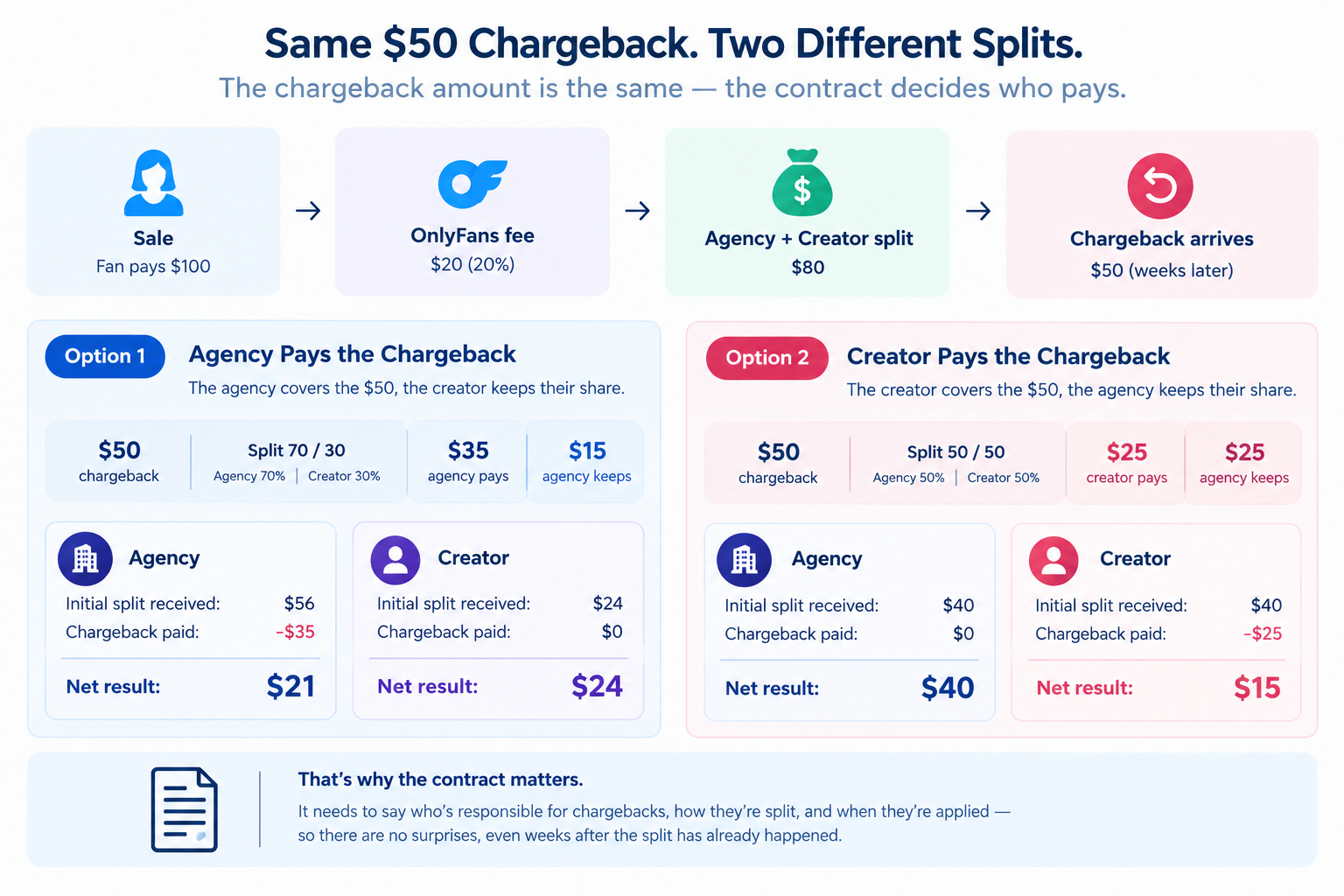
Under the first approach, the creator ends up $16 out of pocket on a sale where she only ever received $24, while the agency keeps money from a sale that no longer exists. Under the second, the sale is reversed for everyone. The second isn't the only reasonable answer, but the contract has to choose one on purpose.
4. What the contract should say
- Who bears chargebacks, and in what proportion: the creator, the agency or both.
- Whether the agency's commission on a reversed sale is returned, and how, for example netted against the next payout.
- How far back a reversal can reach. Some agreements set a window, such as a number of days after the sale.
- The base amount. Fan payment or creator earnings, consistent with whether the split is on gross or net. See [gross vs. net contract math](/blog/gross-vs-net-onlyfans-contract-math).
- Chatter commission on a reversed sale. If a chatter was paid on it, is that reclaimed? See chatter commission structure.
- Evidence sharing. Who gathers the records if a dispute is contested.
- What happens at exit. A chargeback can arrive after a creator leaves, so the agreement should cover that.
A reversal doesn't prove fraud, and neither side should accuse a fan without evidence or promise an outcome that OnlyFans controls.
5. What agencies can do to keep chargebacks down
- Keep clear records of what was sold and delivered in each conversation, since that's the evidence a dispute needs.
- Watch the trend, not just individual cases. A rising chargeback rate on one account is worth looking into early.
- Don't promise what can't be delivered in direct messages. Mismatched expectations are a common source of disputes.
None of this eliminates chargebacks. The goal is fewer of them, and a clear rule for the ones that do happen.
6. What to look for in a payout setup
The structure of the payout matters here. Ask any tool how it handles a deduction that arrives after a split has settled: is it itemized, can both sides see it, and can the netting rule you've written into the contract be applied consistently?
A setup where both the agency and the creator see the same reconciled figures, including adjustments, makes a reversal a visible line item instead of a surprise. We cover what else to ask in questions to ask before choosing payout software. For the legal side of enforcing the terms you choose, see how to enforce a revenue split contract.
Frequently asked questions
Who pays for an OnlyFans chargeback, the agency or the creator?
The deduction comes out of the creator's balance, because OnlyFans' terms say it may deduct the creator-earnings portion. Whether the agency shares that loss depends entirely on the contract between them, which is why it should be written down.
How long after a sale can a chargeback arrive?
It can be weeks later, and sometimes after the payout has cleared and been split. That's why a rule for reversals that land after settlement matters.
Does OnlyFans cover chargebacks?
According to published creator guides, OnlyFans may dispute a chargeback on the creator's behalf, but there's no guarantee of winning and no reimbursement if the dispute is lost.
Should an agency keep its commission on a charged-back sale?
That's a contract decision. Many agreements return the commission on a reversed sale, often by netting it against a later payout, so that neither side keeps money from a sale that no longer exists.
Does a chargeback mean the fan committed fraud?
Not necessarily. A reversal can happen for several reasons, so it isn't proof of fraud, and nobody should accuse a fan without evidence.